Status: Confirmed ARS: Confirmed by ARS assay and 2D gel and identified by 10 genome-wide studies.
Genomic Location:
Chr6:199382-199493
Within tandem intergenic space between YFR022W and YFR023W.
• View at UCSC genome browser
• View on SGD Chromosome Features Map
• View at SGD gbrowser site
• View at Ensembl browser
DNA Sequence:
Origin Sequence Elements: ACS confirmed.
Helical Stability: Minimum -140.2 ΔG° (kcal/mol) at location 199442.
Time of Origin Replication (Trep):
Raghuraman et al. (2001) — Trep: 12.8 min.
Yabuki et al. (2002) — Trep: 20.4 min.
Alvino et al. (2007) — Peak first observed at 10.0 min.
Origin activity in HU: Origin activity detected in HU — more details.
ARS at VI-199 has unique ID: ARS607
ARS at VI-199 has unique ID: ARS607
Chr6:199382-199493
Chr6:195811-202876
Chr6:196969-202450
Chr6:199021-199861
Chr6:197805-200275
Chr6:198200-200300 (orc2-1/wt peak ratio: 0.63)
Chr6:199535-199545
Chr6:198350-201350 (orc1-bah-delta/wt peak ratio: 0.66)
Chr6:196033 (Trep: 12.8 min.) (Confidence: 9)
Chr6:198613 (Trep: 20.4 min.)
Chr6:199330 (Peak first observed at 10.0 min.)
Chr6:200000 (Activity detected in: wild-type, rad53)
Chr6:199382-199493 (Activity detected in: wild-type, rad9, rev3 rad30, eco1, ctf4, ddc1, rad24, pol2-12, elg1, tof1, mrc1-AQ, mrc1-AQ rad9, ctf8, ctf18, mrc1, dcc1, ctf18 rad9, mec1-100, rad53, mec1)
This origin has not been predicted by any curated study.
ARS at VI-199 has unique ID: ARS607
| Shirahige et al. (1993): | G | T | T | T | A | T | A | T | T | T | A | G |
| Xu et al. (2006): | C | T | T | G | T | T | T | A | T | A | T | T | T | A | G | T | T | A | C | G | T | T | G | G | G | A | T | C | A | A | G | T | T | T | ||||||||
| Eaton et al. (2010): | C | T | T | G | T | T | T | A | T | A | T | T | T | A | G | T | T | A | C | G | T | T | G | G | G | A | T | C | A | A | G | T | T | |||||||||
| ACS LOGO: | 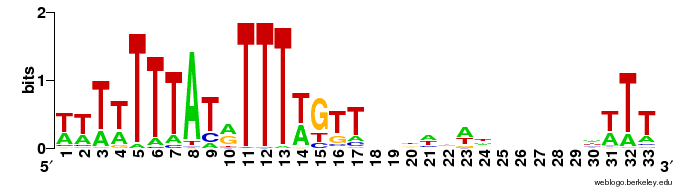 | |||||||||||||||||||||||||||||||||||||||||
ARS at VI-199 has unique ID: ARS607
ARS at VI-199 has unique ID: ARS607
These notes are manually curated. To submit notes for this replication origin site please contact us.
There are no notes entered for this replication origin site.
ARS at VI-199 has unique ID: ARS607
PubMed | PubMed Central | Nat. Cell Biol.
PubMed | PubMed Central | BMC Genomics
PubMed | PubMed Central | Mol. Cell. Biol.
PubMed | PubMed Central | PLoS Genet.
PubMed | PubMed Central | Nat. Struct. Mol. Biol.
PubMed | PubMed Central | Genes Dev.
PubMed | Nat. Struct. Mol. Biol.
PubMed | PubMed Central | BMC Genomics
PubMed | PubMed Central | Genes Dev.
ARS at VI-199 has unique ID: ARS607